
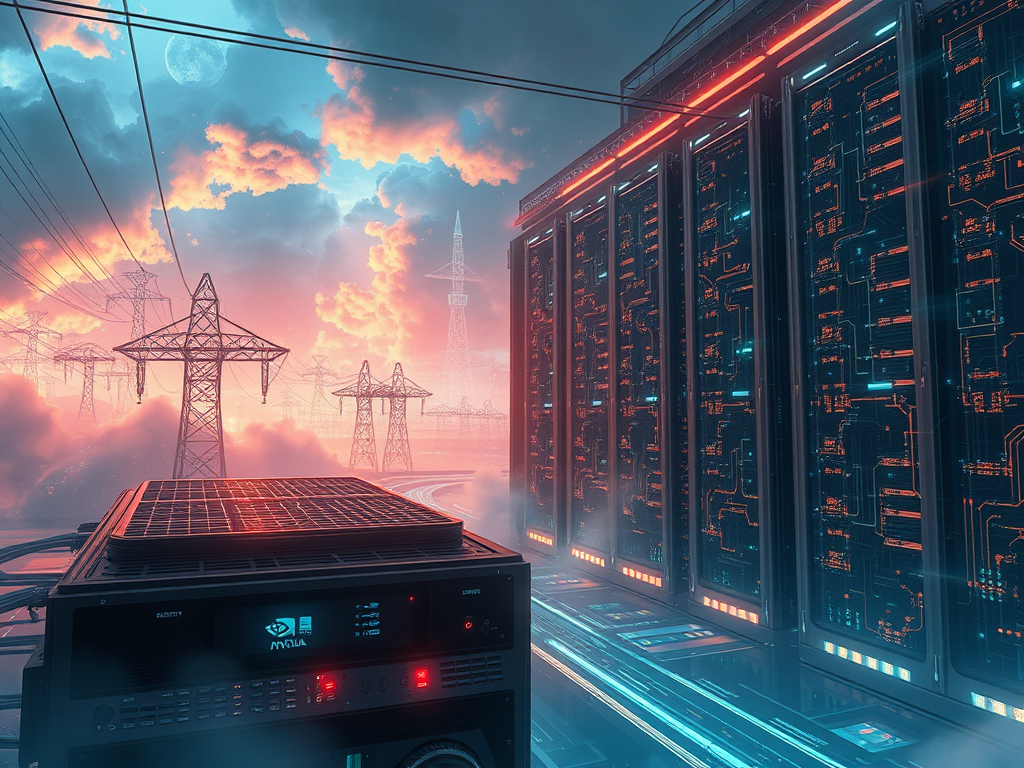
Every few decades, the world witnesses a race that defines a generation.
In the 20th century, it was nuclear arms. In the early 2000s — the internet.
Today, the race is for computing power — the oxygen of the artificial intelligence era.
We are living through the construction of a new industrial base — one built not of steel and concrete, but of data centers, chips, and energy grids.
And the players shaping it — Nvidia, Google, TSMC, and others — are the new architects of modern civilization.
🔋 The Era of AI Industrialization
AI is no longer a software story — it’s an infrastructure story.
Behind every chatbot, autonomous car, and recommendation algorithm lies an enormous ecosystem of servers, chips, fiber cables, and megawatt-scale energy consumption.
The math is staggering:
Training a single large language model (LLM) now requires as much electricity as powering 100,000 homes for a month.
And as AI continues to scale, the demand for compute — and therefore for energy and hardware — is entering a feedback loop of exponential growth.
This is why the AI revolution is no longer confined to Silicon Valley — it now involves governments, oil giants, utilities, and global supply chains.
💥 Nvidia — The Core of Digital Industry
Nvidia has become more than just a chipmaker. It’s the arms supplier in the global digital war.
Recently, the U.S. approved a multi-billion-dollar export of Nvidia chips to the UAE — a move that not only expands Nvidia’s market reach but also deepens its geopolitical footprint.
These are not just semiconductors. They are the engines of the new economy, powering everything from national AI programs to predictive defense systems.
Nvidia’s margins and valuations might seem extreme — but so were those of oil companies during the industrial revolution.
When you sell the most critical resource of the age, you set the price.
🌍 Google, TSMC & The Infrastructure Empire
Google just announced a €5 billion investment in Belgium to expand its European data centers.
This isn’t a vanity project — it’s strategic positioning.
Europe’s demand for AI cloud services is exploding, and Google Cloud wants to anchor itself as the regional backbone.
Meanwhile, TSMC — the silent titan of the semiconductor world — reported 30% year-over-year sales growth, fueled by AI demand.
Every AI chip, from Nvidia to AMD, passes through TSMC’s fabrication plants.
In a world where compute equals power, TSMC’s production lines are as strategically important as oil pipelines were a century ago.
⚡ The New Geopolitical Hierarchy
The AI infrastructure race is rewriting global influence.
- The U.S. dominates chips (Nvidia, AMD, Intel) and cloud computing (Google, Amazon, Microsoft).
- Taiwan remains the manufacturing heart of advanced silicon.
- The Middle East is emerging as the new AI energy hub, with countries like the UAE, Saudi Arabia, and Qatar funding data centers powered by solar and nuclear energy.
- Europe is positioning itself as the regulatory and ethical frontier — slower but stable.
The result is a new digital multipolar world, where computing power replaces traditional energy as the primary lever of economic dominance.
💰 The Investment Landscape
For investors, this isn’t about chasing the next app or startup — it’s about owning the infrastructure that enables intelligence itself.
The capital rotation is already happening:
- Semiconductors → Nvidia, TSMC, ASML, AMD.
- Data center REITs & cloud operators → Equinix, Digital Realty, Google Cloud, Amazon AWS.
- Energy & utilities → Nuclear, renewables, and grid modernization companies.
- AI supply chain → From copper miners to cooling technology providers.
💡 The key insight: AI consumes reality. It eats power, chips, and bandwidth. The companies that supply those will own the future.
🧠 From Innovation to Infrastructure
Just a few years ago, AI was about algorithms. Now it’s about supply chains and sovereignty.
Countries are realizing that without domestic chip production, data storage, and energy independence, they are digitally vulnerable.
That’s why we’re seeing record-level capital expenditure — from trillion-dollar corporations and sovereign funds alike — building the physical layer of the digital age.
📈 The Bottom Line
The next trillion-dollar companies won’t just be writing code — they’ll be building infrastructure for intelligence.
Nvidia, Google, TSMC, and their global counterparts are laying the digital railroads of the 21st century.
Just like the steel barons and oil magnates of the past, they are defining the material backbone of the next economy.
The question for investors isn’t whether AI will grow — that’s a given.
The real question is: are you positioned where that growth physically happens?
Because in this new world, power doesn’t belong to those who use AI — it belongs to those who build it.
With experience and realism,
George Zimmerman
Your broker & market partner




 George Zimmerman's News Feed
Leave a comment